
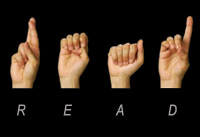
Reading presents a significant challenge for individuals who are born deaf because they cannot hear the language that is encoded by print. The factors that lead to skilled reading for deaf individuals are currently under debate and not well understood. This project uses behavioral, neurophysiological, and neuroimaging measures to identify what factors predict variations in the brain’s response when deaf adults read and recognize written words (e.g., spelling ability, phonological awareness, signing ability, reading speed).
The brain bases of reading in deaf adults
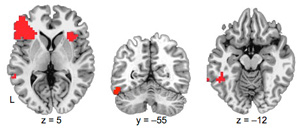
These studies are designed to examine brain functions during reading for deaf people who are bilingual in English and American Sign Language and to understand how the brain systems that support reading are shaped by deafness, e.g., by the changes in visual attention and phonological abilities that result from congenital hearing loss. We use both functional magnetic resonance imaging (fMRI) and electrophysiological measures (EEG/ERP) to investigate neural systems that support reading, fingerspelling, and signing in deaf individuals. We are addressing the following questions:
- What is the neural-behavioral signature for skilled deaf readers?
- Does deafness impact the neural response to visually presented words?
- How does the brain respond to syntactic and semantic errors in English for deaf ASL-English bilinguals?
- Does fingerspelling engage the Visual Word Form Area or elicit an N170?
- How does knowledge of ASL impact word and sentence reading?
Eyetracking studies of deaf readers

Eye movements provide very good clues to how people read words and text. Our lab is now equipped with an Eyelink 1000+ (from SR-Research) eyetracking system which will allow us to determine with great precision where the eyes move when comprehending written text or when viewing sign language. Using this technology, we can ask the following questions:
- What is the source of deaf signers’ wider reading span (the area around fixation from which useful information is obtained)?
- How do deaf signers use their wider reading span to read efficiently?
- Which visual and linguistic processes do skilled deaf readers use during written word processing?
- Do signers activate ASL when they read English text?
Eye tracking studies with adult deaf signers show that they are more efficient when they read sentences compared to hearing readers with similar reading skill. Deaf signers read faster (more words per minute), skip more words, and re-read text less, than their hearing peers – without loss of comprehension! We are currently investigating how deaf signers achieve this feat by studying how they access different types of information when they read (e.g., word length, word meaning) and by comparing their reading behaviors to hearing signers and non-signers.
Funding
These projects are funded by the National Science Foundation (BCS-2120546; BCS 1154313; BCS-1756403; BCS-1439257) and National Institute of Deafness and Other Communication Disorders (R01 DC014246)
Recent Publications
- Sampson, T., Becker, A., Campbell, E., Pyers, J., Hall, W., Sehyr, Z., Czubek, T., DiPerri, K., Henner, J., Emmorey, K.,Petrich, J., Dobbs, C., Lieberman, A., Coppola, M., Langdon, C., Pontecorvo, E., Gappmayr, P., Lim, A., Higgins, M., Napoli, D., Harrison, N., Benedict, R., Holcomb, L., Jones, F., Bottoms, A., Glenn-Smith, E., Clark, D., Gabriel, R., Jiménez, L., Delgado, N. & Caselli, N. (2026). Avoiding unintended consequences: Science of reading policies have potential to harm deaf children. Journal of Deaf Studies and Deaf Education. https://doi.org/10.1093/jdsade/enag004
- Cooley, F., Emmorey, K., Saunders, E., & Schotter, E. (2026). Presenting the Signers’ Eye-movements in English Reading (SEER) Corpus: An eye-tracking dataset of reading behaviors by deaf early signers and hearing non-signers. Behavioral Research Methods. 58:26. https://doi.org/10.3758/s13428-025-02881-2 or email to request PDF
- Glezer, L.S., McCullough, S., Terhune-Cotter, B., & Emmorey, K. (2025). Bilateral word selectivity gradients in the visual word form system in skilled deaf readers. Neurobiology of Language, 1-37. https://doi.org/10.1162/nol.a.13
- Emmorey, K., Akers, E., Saunders, E., Bannazadeh, M., Droubi, E., Cooley, F., & Schotter, E. (2025). Assessing the effects of sign language experience vs. deafness on the leftward reading span. Cognitive Science, 49, e70162. DOI:10.1111/cogs.70162 or email to request PDF
- Sinclair, G., Cooley, F., Stringer, C., Saunders, E., Emmorey, K., & Schotter, E. (2025). The impact of a wider reading span on landing positions and fixation duration: a comparison of deaf and hearing readers. Journal of Experimental Psychology: Human Perception and Performance. https://doi.org/10.1037/xhp0001391 or email to request PDF
- Lee, B., Ortega, S., Midgley, K., Holcomb, P., & Emmorey, K. (2025). Neural associations between fingerspelling, print, and signs: An ERP priming study with deaf readers. Brain and Language, 268. https://doi.org/10.1016/j.bandl.2025.105610
- Saunders, E., Helms, H., & Emmorey, K. (2025). Morphological awareness and reading skill for deaf and hearing adults. Journal of Deaf Studies and Deaf Education, 1-12, https://doi.org/10.1093/jdsade/enaf042 or email to request PDF
- Emmorey, K., Akers, E. M., Martinez, P., Midgley, K.J., & Holcomb, P. J. (2025). Assessing sensitivity to semantic and syntactic information in deaf readers: An ERP study. Neuropsychologia, 215. https://doi.org/10.1016/j.neuropsychologia.2025.109171
- Cooley, F., Emmorey, K., Saunders, E., Sinclair, G., Stringer, C., & Schotter, E. (2025). Identifying text-based factors that contribute to the superior reading efficiency of skilled deaf readers: An eye-tracking study of length, frequency, and predictability. Journal of Experimental Psychology: Learning, Memory, and Cognition, 51(7), 1178-1189. https://dx.doi.org/10.1037/xlm0001415 or email to request PDF
- Saunders, E., Mirault, J., & Emmorey, K. (2025). Activation of ASL signs during sentence reading for deaf readers: Evidence from eye-tracking. Bilingualism: Language and Cognition, 28(1), 208–216. https://doi.org/10.1017/S1366728924000336 or email to request PDF
- Schotter, E., Stringer, C., Saunders, E., Cooley, F., Sinclair, G., & Emmorey, K. (2024). The role of perceptual and word identification spans in reading efficiency: Evidence from deaf and hearing readers. Journal of Experimental Psychology: General, 153(10), 2359–2377. https://psycnet.apa.org/fulltext/2025-33892-001.html or email to request PDF
- Kotowicz J., Banaszkiewicz A., Dzięgiel-Fivet G., Emmorey K., Marchewka A., Jednoróg K. (2024). Neural underpinnings of sentence reading in deaf, native sign language users. Brain and Language, 255, 105447. DOI: 10.1016/j.bandl.2024.105447
- Stringer, C., Cooley, F., Saunders, E., Emmorey, K., & Schotter, E. (2024). Deaf readers use leftward information to read more efficiently: Evidence from eye tracking. Quarterly Journal of Experimental Psychology, 77(10), 20988-2110. https://doi.org/10.1177/17470218241232407 or email to request PDF
- Holcomb, P. J., Akers, E. M., Midgley, K. J., & Emmorey, K. (2024). Orthographic and phonological code activation in deaf and hearing readers. Journal of Cognition, 7(1): 19, pp. 1–16. DOI: 10.5334/joc.326
- Emmorey, K. (2023). Ten things you should know about sign languages. Current Directions in Psychological Science. 32(5), 387-394. https://doi.org/10.1177/09637214231173071
- Sehyr, Z. S., Midgley, K. J., Emmorey, K., & Holcomb, P. J. (2023). Asymmetric event-related potential priming effects between English letters and American Sign Language fingerspelling fonts. Neurobiology of Language 4(2), 361-381. DOI: 10.1162/nol_a_00104
- Winsler, K., Holcomb, P.J., & Emmorey, K. (2023). Electrophysiological patterns of visual word recognition in deaf and hearing readers: An ERP mega-study. Language, cognition and neuroscience, 38(5), 636-650. DOI: 10.1080/23273798.2022.2135746
- Lee, B., Martinez, P., Midgley, K. J., Holcomb, P.J., & Emmorey, K. (2022). Sensitivity to orthographic vs. phonological constraints on word recognition: An ERP study with deaf and hearing readers. Neuropsychologia, 177. DOI: 10.1016/j.neuropsychologia.2022.108420
- Sehyr, Z.S., & Emmorey, K. (2022). Contribution of lexical quality and sign language variables to reading comprehension. Journal of Deaf Studies and Deaf Education, 27(4), 355-372. DOI: 10.1093/deafed/enac018 or email to request PDF
- Sehyr, Z.S., & Emmorey, K. (2022). Contribution of lexical quality and sign language variables to reading comprehension. Journal of Deaf Studies and Deaf Education, 27(4), 355-372 https://doi.org/10.1093/deafed/enac018 or email to request PDF.
- Emmorey, K., Holcomb, P.J., & Midgley, K. M. (2021). Masked ERP repetition priming in deaf and hearing readers. Brain and Language, 214. https://www.ncbi.nlm.nih.gov/pmc/articles/PMC8299519/
- Emmorey, K.,& Lee, B. (2021). The neurocognitive basis of skilled reading in prelingually and profoundly deaf adults. Language and Linguistics Compass, 15(2), e12407. https://pubmed.ncbi.nlm.nih.gov/34306178/
- Emmorey, K.,& Lee, B. (2021). Teaching and Learning Guide for: The neurocognitive basis of skilled reading in prelingually and profoundly deaf adults. Language and Linguistics Compass, 15(2), e12407. https://doi.org/10.1111/lnc3.12410 or email to request PDF.
- Emmorey, K. (2020). The neurobiology of reading differs for deaf and hearing adults. In M. Marschark and H. Knoors (Eds). Oxford Handbook of Deaf Studies in Learning and Cognition, pp. 347–359, Oxford University Press. email to request PDF
- Meade, G., Grainger, J., Midgley, K.J., Holcomb, P..J., & Emmorey, K. (2020). An ERP investigation of orthographic precision in deaf and hearing readers. Neuropsychologia. PMCID: PMC pending https://doi.org/10.1016/j.neuropsychologia.2020.107542
- Meade, G., Grainger, J., Midgley, K.J., Holcomb, P.J., & Emmorey, K. (2019). ERP effects of masked orthographic neighbour priming in deaf readers. Language, Cognition and Neuroscience. PMCID: PMC6781870 https://doi.org/10.1080/23273798.2019.1614201
- Sehyr, Z.S., Midgley, K. J., Holcomb, P.J., Emmorey, K., Plaut, D. C., & Behrmann, M. (2020). Unique N170 asymmetries to visual words and faces reflect experience-specific adaptation in adult deaf ASL signers. Neuropsychologia, 141, 107414. PMCID: PMC7192317 https://doi.org/10.1016/j.neuropsychologia.2020.107414
- Glezer, L. S., Weisberg, J., Farnady, C. O., McCullough, S., Midgley, K.J., Holcomb, P.J., & Emmorey, K. (2018). Orthographic and phonological selectivity across the reading system in deaf skilled readers. Neuropsychologia, 117, 500-512.
- Meade, G., Grainger, J., Midgley, K., Emmorey, K., & Holcomb, P. (2018). From sublexical facilitation to lexical competition: ERP effects of masked priming. Brain Research, 1685, 29-41.
Recent Presentations
- Emmorey, K., Akers, E., Saunders, E., Bannazadeh, M., Droubi, E., Cooley, F., & Schotter, E. (2025). Assessing the effects of sign language experience vs. deafness on the leftward reading span. Paper presented at the Annual Meeting of the Psychonomic Society, November, Denver, CO.
- Schotter, E.R., Cooley, F., & Emmorey, K. (2025). Identifying the sources of reading efficiency: A comparison of individual differences among deaf and hearing readers. Paper presented at the Annual Meeting of the Psychonomic Society, November, Denver, CO.
- Cooley, F., Emmorey, K., & Schotter, E. (2025). Deafness or visual language experience: What drives deaf early signers’ reading efficiency? Paper presented at the Annual Meeting of the Psychonomic Society, November, Denver, CO.
- Akers, E., Midgley, K., Holcomb, P., & Emmorey, K. (2025). Assessing syntactic processing during natural reading in hearing and deaf adults: An EEG/Eye-tracking co-registration study. Poster presented at the Society for the Neurobiology of Language, September, Washington, D.C.
- Magliocco, L., Placer, S., Ortega, S., Midgley, K., Mangun, G., Swaab, T., Emmorey, K., & Holcomb, P. (2025). The neural interaction of reading words and spatial attention. Poster presented at the Society for the Neurobiology of Language, September, Washington, D.C.
- Ortega, S., Grainger, J., Midgley, K., Emmorey, K., & Holcomb, P. (2025). Readers extract syntactic and semantic information during Rapid Parallel Visual Presentation. (RPVP) sentence reading. Poster presented at the Society for the Neurobiology of Language, September, Washington, D.C.
- Cooley, F., Schotter, E., Saunders, E., Sinclair, G., Emmorey, K. (2024). Length, frequency, and surprisal effects: Evidence from a corpus analysis of deaf and hearing readers’ eye movements. Psychonomic Society Meeting, November, New York, NY.
- Saunders, E., Schotter, E., & Emmorey, K. (2024). Parafoveal preprocessing of morphological structure for deaf and hearing readers. Paper presented at the Psychonomic Society Meeting, November, New York, NY.
- Schotter, E., Stringer, C., Saunders, E., Cooley, F., Sinclair, C., & Emmorey, K. (2024). Where and when saccade decisions do not dissociate with perceptual and word identification spans: Evidence from eye movements of deaf and hearing readers. Psychonomic Society Meeting, November, New York, NY.
- Ortega, S., Midgley, K., Holcomb, P., Emmorey, K., & Lee, B. (2024). Reading with hands: the neural relationship between fingerspelling and print. Psychonomic Society Meeting, November, New York, NY.
- Sinclair, G., Cooley, F., Saunders, E., Emmorey, K., & Schotter, E. (2024). The effect of a larger reading span on landing position in deaf readers: An eye-tracking study. Psychonomic Society Meeting, November, New York, NY.
- Emmorey, K. (2024). The unique eye movement profile of deaf readers reveals the plasticity of the reading system. European Conference on Eye Movements, August, Maynooth, Ireland.
- Saunders, E., Schotter, E., & Emmorey, K. (2024). Parafoveal processing of morphological structure for deaf and hearing readers. Paper presented at the European Conference on Eye Movements, August, Maynooth, Ireland.
- Cooley, F., Emmorey, K., Saunders, E., Sinclair, G., Stringer, C., & Schotter, E. (2024). SA corpus study of length, frequency, and surprisal effects in deaf and hearing readers. European Conference on Eye Movements, August, Maynooth, Ireland.
- Akers, E., Midgley, K., Holcomb, P., & Emmorey, K. (2024). Parafoveal and foveal sensitivity to semantic and syntactic violations in deaf and hearing readers: An ERP study. Poster presented at the Cognitive Neuroscience Society meeting, March, Toronto, Canada.
- Ortega, S., Midgley, K., Holcomb, P., Emmorey, K., & Lee, B. (2024). The neural associations between fingerspelling, print, and signs: An ERP study with deaf readers. Poster presented at the Cognitive Neuroscience Society meeting, March, Toronto, Canada.
- Cooley, F., Saunders, E., Stringer, C., Sinclair, G., Emmorey, K., & Schotter E. R. (2023). Rethinking deafness, reading, and bilingualism: Evidence from eye-tracking. Talk presented at the Psychonomic Society Meeting, November, San Francisco, California.
- Stringer, C., Cooley, F., Saunders, E., Sinclair, G., Emmorey, K., & Schotter, E.R. (2023). Deaf readers use leftward information to read more efficiently: Evidence from eye tracking. Poster presented at the Psychonomic Society Meeting, November, San Francisco, California.
- Saunders, E., Stringer, C., Sinclair, G., Cooley, F., Schotter, E., Emmorey, K. (2023). Predictors of word and sign superiority effects for deaf readers. Poster presented at the Psychonomic Society Meeting, November, San Francisco, California.
- Akers, E., Midgley, K., Holcomb, P. & Emmorey, K. (2023). Assessing sensitivity to semantic and syntactic information in deaf readers: An ERP study. Poster presented at the annual meeting of the Society for the Neurobiology of Language, October, Marseille, France.
- Camilliere, S., Midgley, K., Holcomb, P., & Emmorey, K. (2023). ERP evidence for the role of morphology in word recognition by deaf and hearing readers. Poster presented at the annual meeting of the Society for the Neurobiology of Language, October, Marseille, France.
- Sinclair, G., Cooley, F., Stringer, C., Saunders, E., Emmorey, K., & Schotter, E. (2023). Do deaf readers’ larger reading spans impact the ability to target the optimal landing position for word recognition during reading? Poster presented at the Florida Psycholinguistics Meeting, October, Gainesville, Florida.
- Emmorey, K., Akers, E., Holcomb, P., & Midgley, K. (2023). Orthographic and phonological code activation in deaf readers. Paper presented at the European Society for Cognitive Psychology, September, Porto, Portugal.
- Saunders, E., Mirault, J., & Emmorey, K. (2023). Activation of American Sign Language (ASL) signs during sentence reading for deaf readers: Evidence from eye-tracking. Paper presented at Architectures and Mechanisms for Language Processing (AMLaP), September, San Sebastián, Spain.
- Midgley, K. J., Akers, E., Sehyr, Z., Holcomb, P., & Emmorey, K. (2022). Asymmetrical cross-system priming effects between fingerspelled fonts and printed letters for deaf ASL-English bilinguals: An electrophysiological study. Poster presented at the Psychonomic Society meeting, November, Boston, MA.
- Emmorey, K. (2022). The neurobiology of reading differs for deaf and hearing adults. Talk presented for the Mind, Technology, and Society seminar, University of California, Merced, November, Merced, CA.
- Emmorey, K. (2022). The neurobiology of reading in deaf and hearing adults. Talk presented for the Ph.D. in Educational Neuroscience Distinguished Speaker Series, October, Gallaudet University, Washington, DC.
- Emmorey, K. (2022). The neural circuit for reading in deaf adults reflects experience-dependent adaptations. Talk presented at the Society for the Neurobiology of Language, October, Philadelphia, PA.
- Terhune-Cotter, B., Midgley, K., Holcomb, P., & Emmorey, K. (2022). Assessing parallel word processing in deaf readers with an ERP flanker paradigm. Poster presented at the Society for the Neurobiology of Language, October, Philadelphia, PA.
- Saunders, E., Mirault, J., & Emmorey, K. (2022). Activation of ASL phonology during sentence reading: Eye-tracking evidence from deaf readers. Poster presented at the Theoretical Issues on Sign Language Research conference, September, Osaka, Japan (virtual).
- Saunders, E., Mirault, J., & Emmorey, K. (2022). Activation of ASL signs during sentence reading for deaf readers: evidence from eye-tracking. Paper presented at the European Conference on Eye Movements, August, Leicester, UK.
- Emmorey, K. (2022). Language co-activation in bimodal bilinguals; Assessing reading in deaf adults; Neurobiology of sign languages. Lectures presented at the Inclusive Assessment of Multi-modal Multilinguals (IAM3), June, Stockholm, Sweden.
- Camilliere, S., Midgley, K., Emmorey, K., & Holcomb, P. (2022). Masked morphological priming effects in deaf readers: An ERP study. Poster presented at the Cognitive Neuroscience Society Meeting, April, San Francisco, CA.
- Saunders, E., Holcomb, P., Midgley, K., & Emmorey, K. (2022). Assessing the strength of the morpho-orthographic segmentation route for deaf readers using event-related potentials. Poster presented at the Cognitive Neuroscience Society Meeting, April, San Francisco, CA.
- Emmorey, K. (2022). The neurobiology of skilled reading in deaf adults. Scientists in Training Series, Rochester Institute of Technology, April, Virtual talk.
- Camilliere, S., Midgley, K., Emmorey, K., & Holcomb, P. (2022). Masked morphological priming effects in deaf readers: An ERP study. Poster presented at the Cognitive Neuroscience Society Meeting, April, San Francisco, CA. (pdf)
- Emmorey, K.(2022). The neurobiology of skilled reading in deaf adults. Scientists in Training Series, Rochester Institute of Technology, April, Virtual talk.
- Saunders, E., Holcomb, P., Midgley, K., & Emmorey, K. (2022). Assessing the strength of the morpho-orthographic segmentation route for deaf readers using event-related potentials. Poster presented at the Cognitive Neuroscience Society Meeting, April, San Francisco, CA. (pdf)
- Lee, B., Martinez, P., Midgley, K.J., Holcomb, P.J., & Emmorey, K. (2021). Sensitivity to orthotactic and phonological constraints on word recognition: An ERP study with deaf and hearing readers. Poster presented at the Society for the Scientific Study of Reading, July, Virtual meeting.
- Emmorey, K. (2019). The neurobiology of reading in deaf and hearing adults. Distinguished Language Scientists inaugural lecture. University of California, Irvine, December, Irvine, California.
- Emmorey, K. (2019). The neurobiological foundation of skilled reading in deaf adults. Keynote presentation at Teaching Deaf Learners conference, November, Haarlem, The Netherlands.
- Emmorey, K. (2019). What’s the latest research on sign language, fingerspelling, and reading in deaf adults? Invited presentation to the Horace Mann School for the Deaf, October, Boston, MA.
- Emmorey, K. (2019). The plasticity of the reading circuit. Keynote speaker at the 5th International Conference on Cognitive Hearing Science for Communication, June, Linköping, Sweden.
- Lee, B., Mirault, J., Bélanger, N., & Emmorey, K. (2019). No pronounceability effects during sentence reading by deaf and hearing readers. Poster presented at the meeting of Sign Language Linguistics Society (TISLR13). September, Hamburg, Germany. (pdf)
- Massa, N., Emmorey, K., Midgley, K.J., & Holcomb, P.J. (2019). Tracking the time-course of visual word recognition using different types of word-like stimuli. Poster presented at the Cognitive Neuroscience Society, March, San Francisco. (pdf)